Will satellites come to dominate the market for digital infrastructure?
September 2026 | By Stephen Foss
In short, the answer is no. The choice between satellite and terrestrial technology is not binary and there is good reason to expect the two to coexist and work in tandem, building towards a truly global network in which the world’s entire population is within reach of internet access.
That conclusion rests on the relative strengths and weaknesses of each technology and how these steer them towards serving different but coexisting and intertwined markets. Terrestrial infrastructure is expected to continue carrying the vast majority of data, while satellite is better suited to niche markets, built on high value customers and returns but by their nature limited in number.
The Opportunity:
The first point to make is that the opportunity is large enough for both technologies to thrive. According to the market research firm IDC, global data reached 181 zettabytes in 2025, which is expected to increase to 394 zettabytes by 2028. That growth is being driven by cloud computing, AI and an increase in data intensive applications.
The current growth in cloud computing arguably represents a second wave, which is predicted to be bigger than the first. The first wave was about migrating personal data from PCs to the cloud. The second is centred on wider commercial adoption, as businesses recognise that cloud computing carries less security risk than feared while delivering meaningful cost and space savings.
The wider adoption of AI and data intensive applications have further strengthened the commercial case for cloud computing, as reflected in the greater flexibility and compute power needed to manage more demanding applications, as we increasingly ask the internet for answers rather than information.
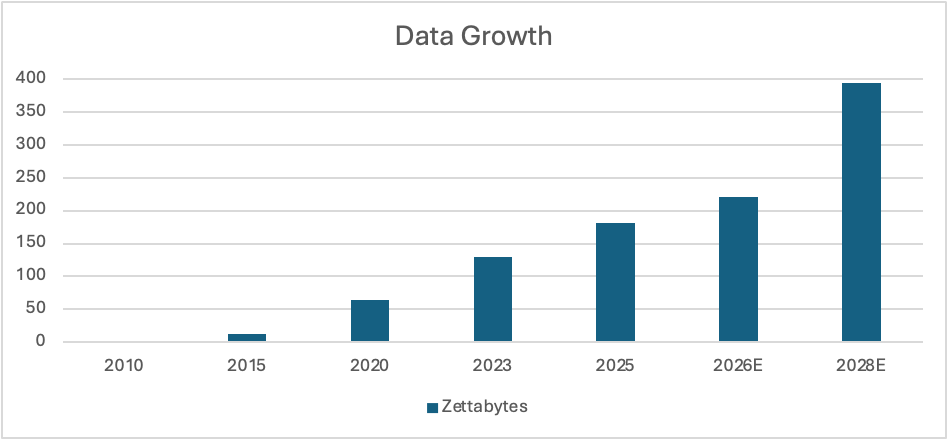
(IDC / Statista Forecasts)
There is also a substantial opportunity in widening network reach to the 3.4 billion people worldwide who do not currently use mobile internet. Of these around 300 million (circa 4% of the world’s population) live in areas with no mobile signal at all, while the remaining 3.1 billion have access to coverage but are not connected, for reasons that include costs.
Strengths and Weaknesses:
Structural growth in data provides a positive tailwind for both terrestrial and satellite infrastructure but, the split between them is far from even, with terrestrial expected to carry as much as 97%[i] of data in the future. The reasons for this lie in capacity, regulation, practical and commercial limitations.
Satellite signal capacity is limited by distance, coverage area and the power of the satellite itself, which reduces its ability to serve densely populated areas effectively, or locations where there is signal interruption, such as buildings, tunnels and regions with dense foliage.
The next generation of low earth orbit satellites (LEO), traveling at altitudes between 350km and 500km, will deliver a signal (or beam) with a defined amount of capacity over a typical area of c.160km². Because that capacity is finite, when divided by a greater number of users, the effective services each user receives becomes increasingly limited. Signal strength cannot be improved by overlapping beams without interference. In contrast, a terrestrial signal has greater capacity and covers an area of only a few hundred meters. So, when divided by a greater number of users each can access a significantly more robust service.
To put some numbers on this, the next generation of LEO satellites can fit only 14 beams within the area of the M25, with the ability to serve c.7,000 users. In comparison, the estimated 11,000 terrestrial sites that exist today within the M25 cater for 13 million people[ii].
While there’s an option to increase signal strength by increasing the network of satellites, this is limited by commercial considerations, as well as the need to have distance between satellites and to avoid debris. The strength of satellite beams can be increased by using technologies such as beam forming, narrowing the beam’s coverage area to concentrate signal, but this does not solve the underlying problem, as capacity remains far inferior to that of terrestrial networks.
Terrestrial infrastructure also benefits from flexibility. It is relatively easy to increase or decrease capacity in any given area according to population and user density. Satellites, by contrast, are constrained by the limited power available from their solar panels and batteries.
Terrestrial networks benefit from frequency reuse: because signal areas are small, the same frequency can be deployed at different locations, provided they are sufficiently distanced to avoid interference. Two radio stations, for example, can share a frequency in different parts of the country. This allows operators to use their allocated spectrum far more efficiently.
Bandwidth, or more typically referred to as spectrum, is closely regulated, with terrestrial or satellite service providers allocated certain frequencies which they must keep to. This means that satellite services are unable to use different frequencies to cross beams and strengthen their service in individual areas, again limiting satellite capacity.
Spectrum is highly regulated because it is finite, and different operators cannot use the same frequency within a given area without interference. It can be seen as a motorway, split into different lanes, each offering different speeds and signal strength and application suitability. Within each lane there are a set number of frequencies for allocation. Because it is vital that each operator sticks to their allocation, spectrum is regulated at national and international levels.
Additionally, there are also practical limitations which include, for example, redundancy. It is far easier to introduce redundancy systems into terrestrial infrastructure than satellite infrastructure, allowing the service provider to better maintain service levels in the event of technical or other failures in the system integrity. The practical limitations of satellite service redundancy therefore have knock-on implications for what services, particularly critical ones, should be hosted by the different technologies.
While the business model for satellite services has greatly improved, based on the decrease in cost of placing a satellite in orbit, there remain material commercial considerations. A key factor is that LEO satellites typically require replacement every 5 years, driving a constant capex cycle. That is of course assuming that once in orbit the satellite remains reliable. It is, after all, relatively easy to repair equipment on the ground but completely impractical, if not impossible, to do so in space.
For integrated service providers, like Starlink, which can take advantage of ultralow launch costs, the IRR is estimated to remain healthy but for those relying on customer launch rates, commercial viability is much less clear. That is, unless, like Amazon’s Leo, the purpose is to drive advantage over wider commercial business centres, like Amazon Web Services, or where you’re able to command premium rates by offering a superior, uninterrupted service for specialist markets, such as Europe’s OneWeb.
Different strengths drive different markets:
The strengths of terrestrial infrastructure naturally lend themselves to areas of higher population and user density. These areas represent most of the world’s population, with terrestrial networks currently covering c.96%[iii]. Its superior signal capacity and density mean terrestrial networks can not only maintain a service indoors and in other environments prone to interruption.
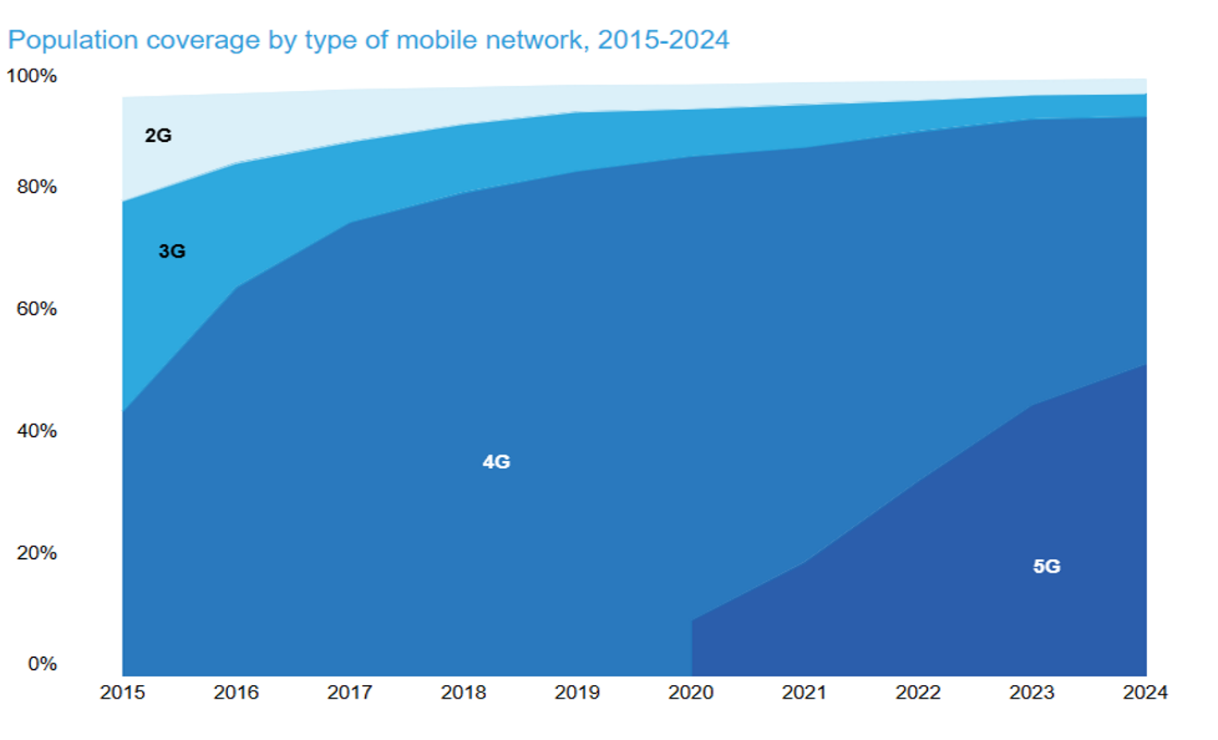
(The International Telecommunication Union Website)
Satellite’s strengths, by contrast lend themselves to remote areas and to specialist, often high value markets such as marine, aviation, crisis response and defence. It’s worth noting that most current satellite broadband capacity sits in LEO, but geostationary (GEO) and medium earth orbit (MEO) satellites, such as those operated by Viasat, SES and Intelsat, continue to serve distinct use cases including broadcast and fixed enterprise links, with different capacity and latency profiles to LEO. By their very nature, the remoteness or the small number of users within them, makes it difficult or commercially unviable for terrestrial networks to serve them at all.
Even within these markets, there is scope for terrestrial and satellite infrastructure to combine their respective strengths and offer a more complete, integrated service. For example, using satellite links for backhaul and network resilience where microwave and fibre connectivity is impractical. This is reflected in the increasing number of partnerships between Mobile Network Operators (“MNOs”) and satellite service providers, such as T-Mobile’s and Virgin Media O2’s agreements with SpaceX (Starlink), Vodafone’s agreements with AST SpaceMobile and Orange’s agreement with Eutelsat (OneWeb).
Conclusion
Satellite infrastructure is not going to replace terrestrial infrastructure, and for good commercial and practical reasons that are unlikely to change.
There is good reason to believe there is the opportunity for both types of infrastructure to thrive. Underpinned by structural growth in demand for data and by strengths that suit each to different applications and markets.
Nonetheless, based on the laws of physics, combined with the practical limitations of bandwidth, regulation and commerciality, it is highly realistic to believe that the vast majority of data will remain on terrestrial networks. For infrastructure investors, this reinforces rather than undermines the long-term investment case for terrestrial digital infrastructure. The structural growth in data combined with terrestrial’s enduring capacity and cost advantages, means towers, fibre and data centres remain the primary beneficiaries of rising global data consumption, while satellite operators compete for a smaller, more specialised pool of high-value, low-density use cases.
Rather than being a threat, satellite’s growing role as a complement, providing backhaul, network resilience and connectivity in areas terrestrial cannot reach commercially, should be viewed as additive to terrestrial network economics, deepening partnerships between MNOs and satellite operators rather than displacing ground-based assets.
For investors assessing where capital is best deployed within digital infrastructure, the physics and economics both point the same way: the bulk of durable, scalable returns will continue to sit with terrestrial networks, with satellite representing a smaller, complementary allocation rather than a competing one.
[i] Helios Towers– The Future of Connectivity Report
[ii] Helios Towers – H1 Results 2026 & Multi-Decade Growth Runway
[iii] The International Telecommunications Union – Facts and Figures 2024 – Mobile network coverage